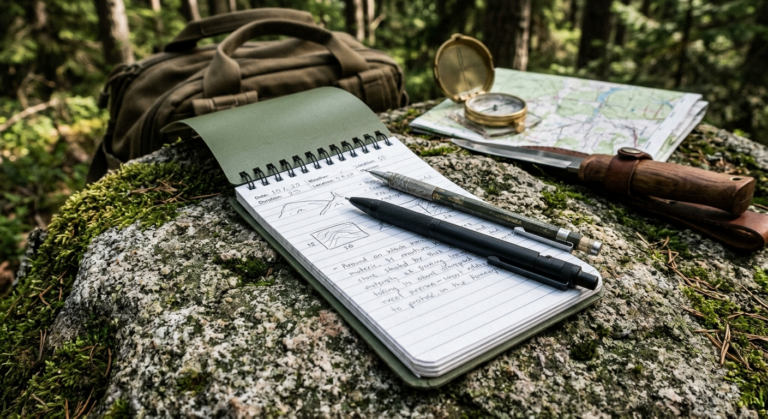
Imagine you are three days into a backcountry trip or navigating an off-grid survival scenario. The weather shifts suddenly, temperature plummets, and your smartphone battery shuts down from the extreme cold. Your GPS unit flashes a dead battery icon, leaving you without access to digital maps or saved survival guides.
In a real wilderness emergency, high-tech gear fails when you need it most. That is precisely why seasoned survivalists, military operators, and wilderness guides rely on low-tech, zero-failure tools—starting with a physical survival field journal.
Keeping a weatherproof field log isn’t just about recording memories; it is a vital survival tool that sharpens your situational awareness and preserves critical information offline.
1. Offline Intelligence: Preserving Life-Saving Survival Knowledge
When disaster strikes or you are lost in the bush, trying to recall local edible plants, emergency first-aid protocols, or specific knot-tying steps purely from memory creates room for fatal mistakes.
A survival field journal acts as your personal, waterproof database for critical wilderness survival knowledge.
Essential Data to Record in Your Survival Journal:
- Foraging & Edible Plants: Local edible and medicinal plant logs, complete with sketched leaf patterns and toxic lookalikes.
- Land Navigation & Waypoints: Hand-drawn topographical landmarks, compass bearings, reliable water sources, and emergency exit routes.
- Primitive Firemaking & Shelter Notes: Which tinder sources work best in high humidity and which shelter designs held heat overnight.
- Medical Logs: Group medical histories, allergy notes, dosage tracking, and injury treatment logs during extended emergencies.
2. Weather Tracking and Pattern Recognition
n a survival scenario, predicting an incoming storm two hours early can mean the difference between staying dry in an improvised shelter or suffering from hypothermia.
By recording atmospheric conditions regularly, you can track microclimates and predict sudden weather changes without relying on a cell connection.
| Parameter | Survival Significance |
| Barometric Trend | Sharp drops indicate fast-approaching storm fronts. |
| Wind Shifts | Changes in prevailing wind reveal shifts in regional air masses. |
| Cloud Formations | Early warning sign for high-altitude thermal instability. |
| Temperature Drops | Helps calculate dew point and nocturnal freeze risks. |
3. Top Survival Field Journaling Gear (Affiliate Product Recommendations)
To ensure your logbook survives heavy rain, river crossings, and rough handling, you need battle-tested, weatherproof gear. Below are the core tools every survivalist should carry in their bug-out bag or chest rig.
1. Waterproof Notebooks
Standard paper disintegrates when wet. You need synthetic, water-resistant paper that resists mud, oil, and sweat.
- Top Pick: Rite in the Rain All-Weather Pocket Notebook – Highly durable, fits inside a standard tactical shirt pocket, and completely repels water.
2. All-Weather Writing Instruments
Regular ballpoint pens freeze, and ink smears across wet pages. Pencils or pressurized pens are mandatory.
- Top Pick: Fisher Space Pen Matte Black – Writes upside down, underwater, over grease, and in temperatures from -30°F to 250°F.
- Budget Alternative: All-Weather Mechanical Pencils – No sharpening required; graphite will never freeze or bleed on paper.
3. Protective Field Covers
Protect your journal, compass, map tools, and pens in one organized, MOLLE-compatible pouch.
- Top Pick:Tactical Cordura Field Journal Cover] – Heavy-duty zippers, pen slots, and rugged fabric built for harsh field environments.
4. The Standard Survival Log Entry Format
When fatigue and stress set in, keeping a structured entry format ensures you capture vital information quickly without wasting time.
Use this standardized header for every field log entry:
DATE/TIME: 14 OCT 2026 / 08:30 HRS
GRID/COORD: 44°12’N 121°40’W (ELEV: 3,400 FT)
WEATHER: 42°F | WIND: W 10 MPH | BARO: 29.85 FALLING
CAMP SETUP: Lean-to shelter on east ridge; dry tinder gathered.
Prepare Your Survival Kit Today
A survival field journal is one of the lightest, most affordable, and most reliable pieces of survival gear you can carry. It never runs out of power, withstands extreme elements, and preserves life-saving knowledge when technology fails.
Equip your bug-out bag with an [Insert Your Affiliate Link Here – All-Weather Field Journal Kit], toss a pressurized pen in your pack, and start building your personal wilderness playbook on your next outdoor trip.